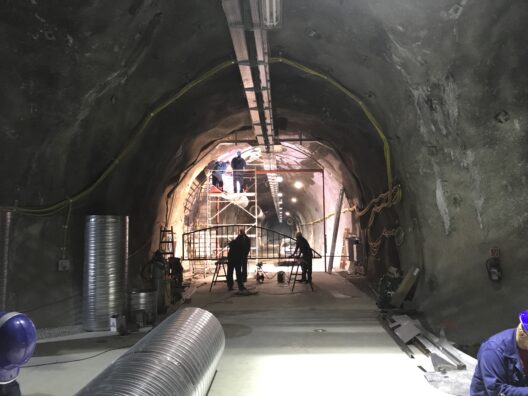
The development of the Bátaapáti National Radioactive Waste Repository (NRHT) is a critical infrastructure project in Hungary aimed at the final, geologically safe disposal of low- and intermediate-level radioactive waste from nuclear power plants. During Phase III, Section III of the project, the WHB Group constructed the reinforced concrete basin for the I-K2 storage chamber and expanded the technological systems in accordance with extremely high quality and safety requirements.
Location and geological setting
The Bátaapáti mine is located 250 meters underground in a shaft system carved into a 340-million-year-old granite massif. The storage system consists of several chamber complexes, each with a volume of 400–600 m³, which were developed through precise engineering and under strict geological conditions. The clayey, stable geological layers ensure the necessary protection and isolation for the long-term containment of the waste.
Main technical content
The work carried out by WHB involved the reinforcement of the reinforced concrete basin of the I-K2 camera and the addition of process systems, as part of the NRHT’s ongoing expansion program. The reinforced concrete structures were constructed using special, low-heat-generating concrete mixes, which were either produced at the Paks channel-type container factory or specially prefabricated.
Low- and intermediate-level waste is stored in special reinforced concrete containers, which are subsequently sealed with concrete plugs and layers of clay, ensuring a multi-level, redundant protection system.
Quality Management and Safety Requirements
The project was carried out under a NATO-compatible quality management system (AQAP 2110:2016) and subject to national security classification, which requires the highest levels of precision, traceability, and documentation. Every single reinforced concrete element, concrete pour, and installation phase was subject to strict inspection and documentation to ensure compliance with nuclear safety requirements.
Results and Added Value
The I-K2 chamber and technological expansion implemented by WHB contribute to increasing the capacity of the NRHT, thereby ensuring the long-term, safe, and final disposal of low- and intermediate-level waste from Hungary’s nuclear power plant. The work performed on this project demonstrates WHB’s ability to participate effectively in critical, national-security-level nuclear infrastructure projects and to comply with the highest technical and safety standards.