One of the greatest benefits of digitalization is that it simplifies and improves the transparency of information management. Today, the success of a construction project depends not only on professional experience and construction expertise, but also on how quickly, accurately, and consistently project stakeholders can work with data, drawings, documentation, and feedback. Bluebeam, for example, supports construction project documentation management, drawing reviews, and collaboration, while digital document management reduces the time spent on manual tasks.
The construction industry of the future is built on collaboration. Modern digital platforms enable project teams to share information more quickly, track changes more easily, and manage documentation in a more consistent manner. Bluebeam also enhances teamwork by allowing colleagues to share drawings, comments, and revisions more efficiently, helping to reduce misunderstandings. This way of working not only improves day-to-day efficiency but also contributes to projects advancing through more transparent, traceable, and higher-quality processes.
However, development cannot be measured solely by software and digital systems. Knowledge sharing, supporting the next generation of professionals, and fostering a corporate culture that encourages continuous learning are equally important. Through the summer internship program launched at the Regional Construction Training Center (ÉRKK), interns participate in design and pre-construction activities under professional mentorship, while WHB employees gain access to drawing review support. This collaboration serves two important purposes simultaneously: supporting project operations and promoting the development of young professionals. Employees receive assistance with preparatory tasks, while students gain valuable hands-on experience through real-life projects.
Drawing review support can assist with specific tasks such as quantity take-offs for wall and floor finishes, suspended ceiling verification, and the preparation or review of schedules and finish specifications. These often behind-the-scenes and highly detailed professional processes have a significant impact on a project’s preparedness and efficiency. For this reason, progress at WHB is not only represented by visible technological innovations but also by process improvements that strengthen the quality of everyday project work.
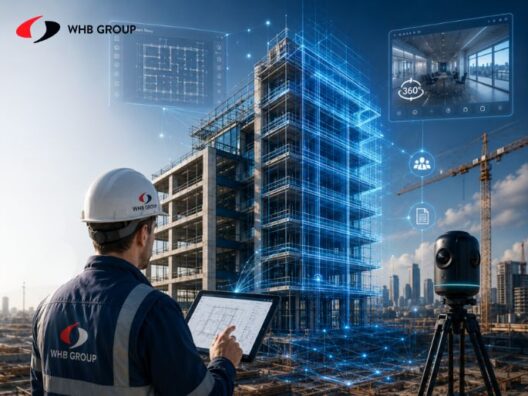
Another key area of digitalization is the modern documentation of building conditions. WHB’s new 360-degree building condition survey and virtual walkthrough service enables interior spaces to be documented quickly, easily, and efficiently. The captured data can be transformed into an interactive virtual tour that can be accessed anytime and from anywhere through a simple web link. This solution elevates the sharing of site information to a new level, allowing project participants to gain a comprehensive understanding of a building’s current condition without the need for repeated site visits.
The 360-degree virtual walkthrough is particularly valuable for projects involving multiple disciplines or where documentation must be shared with several colleagues and external partners. The easily shareable online virtual tour can reduce the need to transfer large files and organize repeated site visits. This perfectly demonstrates how digitalization becomes a natural part of daily operations: not by making processes more complicated, but by making collaboration simpler, faster, and more accessible.
At WHB, innovation is not viewed as an isolated development but as an interconnected operational culture. Bluebeam training supports standardized digital document management and drawing review processes; the drawing review support provided through ÉRKK helps relieve project teams while also supporting the practical development of interns; and the 360-degree building condition survey offers a new perspective for capturing and sharing the current state of buildings. Together, these initiatives point in the same direction: toward a more modern, transparent, efficient, and collaborative construction industry.
The future of construction is not a distant vision but a reality being shaped through everyday practice. Every new digital tool, every improved process, every piece of shared knowledge, and every professional collaboration contributes to WHB remaining a strong, competitive, and future-focused player in a constantly evolving industry. The use of modern digital solutions is increasingly becoming an industry expectation, and familiarity with these technologies provides advantages not only at the corporate level but also for individual professional development.
For WHB, progress is about bringing together experience, expertise, and innovation so that they reinforce one another throughout its projects. In this way, digitalization becomes more than a standalone technological issue; it becomes one of the foundations of high-quality, efficient, and future-ready construction operations.