Inclusion in Everyday Practice
An inclusive workplace is not a slogan printed on posters—it is a practice lived every day. At WHB, inclusion is not a separate program or campaign; it is a natural part of how the company operates. It is rooted in the belief that a person’s value is defined not by their limitations, but by their knowledge, attitude, and commitment.
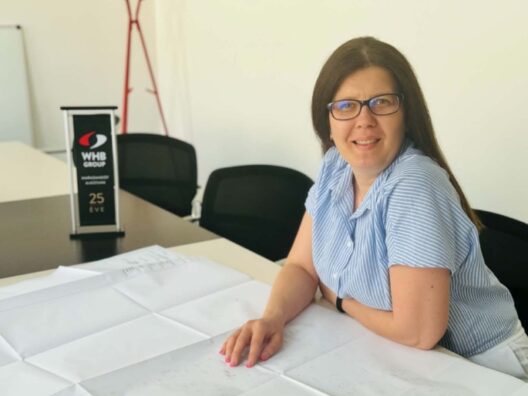
Eszter Várady, HR Manager, spoke with Ildikó Popovics, a Technical Preparation Specialist at WHB, who has been working at the company for more than a decade as a hearing-impaired professional in an industry that many still consider male-dominated and difficult to access. Her experiences tell a different story: in a supportive environment built on empathy and mutual understanding, genuine professional communities can thrive.
The conversation below is more than the story of one individual’s career path. It is an authentic example of how inclusion can become part of everyday business operations—and how a large company can provide security, stability, and opportunities for professional growth to all of its employees.
“They Never Defined Me by My Limitations” – The Beginning at WHB
Eszter Várady: Please introduce yourself. How long have you been working at WHB, and what are your responsibilities?
Ildikó Popovics: I joined WHB in March 2014 as a recent graduate at the very beginning of my career. Since day one, I have worked as a Technical Preparation Specialist, primarily supporting construction projects. Before that, while still in college, I gained experience in a family business where I prepared residential building plans using Archicad and assembled the documentation required for permit applications. Although I learned a great deal, I quickly realized that I was looking for more diverse and complex challenges. Someone I knew mentioned WHB, I applied for a position, and I have been here ever since.
What are your memories of those early days?
Back then, WHB was a much smaller and more family-oriented company. My first impression was extremely positive, and I still remember my job interview vividly. I was surprised to be greeted not by two people, but by five in the Győr office. However, the atmosphere was so welcoming that any tension quickly disappeared. Our current Managing Director, Balázs Dénes, played a particularly important role in making me feel at ease. Even then, I had the feeling that I had found the right place both professionally and personally.
What has kept you here over the long term?
Empathy and flexibility. At WHB—from senior management to my closest colleagues—I have never felt that my hearing impairment was viewed as a burden. From the very beginning, it was clear that nobody saw it as an obstacle. We always looked for solutions through written communication, attentiveness, and mutual adaptation. Having a stable team and a supportive environment provides a strong sense of security, and it is rewarding to continue growing professionally in such a setting.
Everyday Work Supported by Understanding and Care
What challenges do you face in your daily work as a hearing-impaired professional?
Often, it is not immediately obvious that I am hearing impaired, so colleagues do not always realize it at first. Once they become aware of it, however, I am usually met with understanding and openness. The biggest challenge is ensuring a continuous and accurate flow of information. For example, if a contractor does not respond to my emails, my colleagues immediately step in to help—they make phone calls and follow up without hesitation. That support means a great deal to me.
Was there ever a moment that reassured you that you were in the right place?
Yes. On my second day at work, I was thrown straight into the deep end. While working on the House of Hungarians project, a site manager initially had concerns about how we would collaborate. After only a few days, however, it became clear that our cooperation was completely seamless. When he later told me that he had been pleasantly surprised, it was incredibly affirming—not only professionally, but personally as well.
What helps you most in your day-to-day work?
Directness and clear communication. Because I rely on lip-reading, it is important not to be overwhelmed by too many stimuli at once. Many of my responsibilities involve written, independent work, such as preparing requests for quotations, price comparisons, reports, and technical documentation. My team is flexible, attentive, and always willing to help find solutions. That is what truly makes our collaboration successful.
Inclusion in Practice – What Does Security Mean in a Large Company?
How do you experience WHB’s workplace culture as an employee with reduced work capacity?
Honestly, I have never had a negative experience here. Inclusion is not something that requires special effort—it is simply a natural part of everyday life. My colleagues are considerate, supportive, and I never feel that I need to overexplain anything. That sense of security is what encourages people to stay with a company for the long term.
Have you ever experienced discrimination or disadvantage in the workplace because of your hearing impairment?
Unfortunately, discrimination is not an unfamiliar experience in my life. However, I have never encountered it at WHB. I do not believe that my hearing condition should be viewed as a disadvantage, although there are objective challenges—for example, using the telephone is simply not an option for me. What matters most is that I can face these challenges within an accepting team, where we look for solutions together rather than treating them as problems.
Would you describe WHB as an accepting, neutral, or supportive environment?
It depends on the situation. Long-standing colleagues know me well; they accept me, support me, and help whenever they can. With new colleagues, the situation is often neutral at first, simply because they may not yet know that I am hearing impaired. As we begin working together and get to know each other, that quickly develops into an accepting and supportive working relationship. Overall, I experience WHB as an inclusive workplace.
Do you think it is important to speak openly about these issues in a corporate environment?
Absolutely. I often find that reduced work capacity creates uncertainty because people lack experience, do not know what to expect, and are afraid to ask questions. In reality, a little guidance is usually all that is needed. Whenever I help people better understand the situation, they visibly relax, and their attitude changes completely. I believe that many of these situations simply require a bit of encouragement and openness.
Succeeding as a Woman and a Professional in a Male-Dominated Industry
What is it like to work as a woman in the construction industry, which many still see as male-dominated?
As a woman, it may indeed be somewhat more challenging to establish yourself in this profession, but it is by no means impossible. It requires professional expertise, self-confidence, and determination. I am proud of how far I have come both as a woman and as a person with reduced work capacity. Many people still ask me with genuine surprise how it is possible to succeed in such a demanding and traditionally male-dominated field.
Have you ever felt that you had to prove yourself twice as much because you are both a woman and a person with reduced work capacity?
Yes, and that is not limited to my profession—it has been a recurring theme throughout many areas of my life. I often have to invest more energy to achieve the same results. At the same time, those experiences have made me stronger and more self-aware over the years.
Ten Years of Learning and Growth – Professionally and Personally
What has these ten years at WHB given you, both professionally and personally?
I consider construction to be a field where there is always something new to learn, which I find incredibly inspiring. It feels rewarding to know that my contribution matters on projects. Over the years, WHB’s technical and professional capabilities have developed significantly, making everyday work easier while also creating new opportunities for continuous development.
Is there a lesson that has become particularly important to you over the years?
I believe that success is impossible without resourcefulness. I have had to learn how to step outside my comfort zone, overcome challenges, and constantly seek solutions that are acceptable to everyone and sustainable in the long term.
A Personal Message to Employers and Employees
What would you say to employers who are still uncertain about hiring people with reduced work capacity?
I believe that every employee with reduced work capacity deserves an opportunity, provided that they are offered a position suited to their condition and the tools necessary to perform their job successfully. Their professional expertise can bring genuine value to an organization. They can inspire others, contribute new perspectives, and there is a great deal that can be learned from them.
Closing Thoughts – More Than a Workplace
Is there a single sentence that best summarizes what WHB means to you?
I hope that one day I will be able to say that this was the best and most human-centered workplace of my life—a place that left a lasting impact on me.
Closing Reflections from the HR Manager
Ildikó’s story clearly demonstrates that an inclusive workplace is not defined by a special set of rules, but by human attitudes and values. At WHB, reduced work capacity is not seen as a limitation, but as an individual characteristic to which both the organization and the community adapt with flexibility and understanding.
The fact that one of our hearing-impaired colleagues has worked with dedication at our company for more than ten years is, in itself, strong validation of this approach. Long-term success is built on trust, mutual respect, and a supportive workplace culture.
For WHB, building the future is not only about projects—it is also about people: employees who can contribute to shared success in an environment where they feel safe, valued, and treated as true partners.– Eszter Várady, HR Manager