Artificial intelligence has quickly become one of the defining topics of economic and technological discourse. While its application is already becoming part of everyday operations across many industries, its potential to create tangible value in construction is only now beginning to take shape.
A construction project operates within an extremely complex information environment. Plans, contracts, schedules, technical documentation, cost data, change management processes and site reports all need to be continuously coordinated. The larger and more complex the project, the more important it becomes for decision-makers to have timely access to the information that truly matters.
Turning Information into Decisions
In construction, the challenge is often not a lack of information, but its sheer volume and fragmentation. Project stakeholders work with vast amounts of documentation, while the time available for making decisions is often limited.
AI-powered systems can support the organisation of documents, the identification of discrepancies and correlations, and the faster review of information required for decision-making. There is also significant potential for analysing scheduling data, supporting repetitive administrative tasks and identifying project risks at an earlier stage.
At the same time, AI can only create genuine value when it is supported by high-quality data, clearly defined processes and appropriately skilled professionals.
Experience Cannot Be Automated
Many decisions on a construction project are highly context-dependent. They require consideration of technical interdependencies, site-specific conditions, the capabilities of project partners, the contractual framework and the long-term implications of each decision.
Artificial intelligence can identify patterns and highlight potential deviations, but it cannot assume professional responsibility. Engineering judgement, accumulated experience and responsible decision-making will remain essential.
The true role of AI is therefore not to replace human expertise, but to augment it. It can help professionals spend less time on routine information processing and devote more attention to critical technical and business decisions.
Not a Technological Showcase, but an Operational Improvement
One of the greatest risks of adopting AI is for companies to invest in technology for its own sake. A sophisticated or visually impressive system does not necessarily result in more efficient operations.
The first question should always be: what real problem are we trying to solve? Can a workflow be made faster? Can information loss be reduced? Can a risk be identified earlier? Can decision-making become more accurate or transparent?
AI and BIM are already emerging as areas of focus across several of WHB’s internal development initiatives, while digitalisation remains one of the company’s key strategic priorities.
The Competitive Advantage Will Lie in How AI Is Applied
Over time, more and more companies will gain access to artificial intelligence. That, however, does not mean that all organisations will be equally prepared to make effective use of it.
The difference will lie in how effectively an organisation can integrate new technologies into its existing processes, the quality of the data it has at its disposal, and its ability to prepare its people for new ways of working. AI in itself is not a competitive advantage. Its responsible and purposeful application can be.
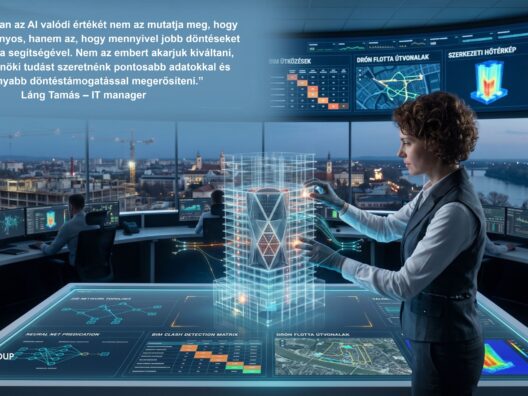
“In construction, the true value of AI will not be measured by how impressive it looks, but by how much better the decisions we make with its support become. We are not looking to replace people; we want to strengthen engineering expertise with more accurate data and more effective decision support.”
Tamás Láng – IT Manager