When a development is completed, the public primarily sees the end result: the building, its spaces, facade and surroundings. Yet much of the expertise behind its realization remains invisible.
What cannot be seen are the thousands of decisions that had to be made throughout the project. The coordination between different disciplines, risk assessments, procurement processes, quality controls and rapid interventions that resolved potential issues before they could affect the project as a whole all remain behind the scenes.
Yet this professional framework operating in the background is precisely where a contractor’s true value lies.
Experience only creates value when it can be shared
Experience carries particular importance in the construction industry. Many situations cannot be resolved solely by relying on textbooks, standards or regulations. They require professionals who can recognize risks based on previous projects, understand the consequences of their decisions and find appropriate solutions even in complex circumstances.
At the same time, experience can easily remain tied to individuals. At a corporate level, one of the most important challenges is therefore ensuring that the knowledge accumulated by colleagues is not lost, but can be transferred and applied across other projects.
Documented processes, professional collaboration, internal knowledge sharing and digital systems all help ensure that lessons learned from one project can contribute to the success of the next.
Construction today is a complex knowledge-based service
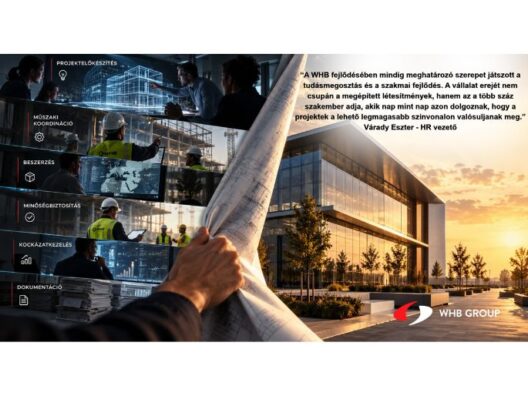
The role of a modern general contractor extends far beyond the physical management of a construction site. A complex project requires technical, financial, legal, safety, quality management, procurement and information management expertise to be integrated into a single, coordinated system.
For this reason, clients are not simply purchasing capacity. They are looking for a professional partner capable of understanding and coordinating a process involving numerous stakeholders, identifying risks at an early stage and finding effective solutions to unexpected situations.
WHB’s professional expertise has been shaped by nearly 30 years of experience across a wide range of project environments. Energy and industrial investments, institutional developments, office and logistics facilities, and the restoration of historic buildings all present different challenges. The experience gained from this diversity becomes genuine corporate value when knowledge can be transferred between projects.
People and technology
Digitalization is making an increasing number of processes more transparent and measurable. BIM systems support multidisciplinary coordination, data-driven project monitoring facilitates better decision-making, while artificial intelligence can open up new possibilities for processing information and identifying potential risks.
Rather than diminishing the importance of human expertise, these developments make it even more valuable. Alongside digitalization, WHB considers it essential to connect the knowledge of different generations: younger professionals who are open to digital solutions, colleagues with a strong professional knowledge base and senior experts with decades of experience.
The future of knowledge in construction is therefore not about choosing between experience and technology. It is about how effectively the two can be combined, and how successfully knowledge can be transferred across generations, disciplines and projects.
Knowledge as a foundation of trust
At the beginning of a project, clients cannot anticipate the outcome of every decision that will need to be made. They therefore require a professional partner that can clearly explain the available options, identify risks in good time and responsibly represent the long-term interests of the project.
Ultimately, a company’s professional strength is not measured by whether it never encounters unexpected situations. What truly matters is how quickly it identifies a problem, how well prepared it is to respond and what kind of solution it is able to provide.
“Behind every completed building are not one or two major decisions, but thousands of professional choices. Our responsibility is to bring together the experience of our colleagues, our corporate processes and the opportunities offered by technology into a unified body of knowledge. In the long term, what will define a company is not how much information it possesses, but the quality of the decisions it is able to make based on that information.”
Eszter Várady, Head of HR