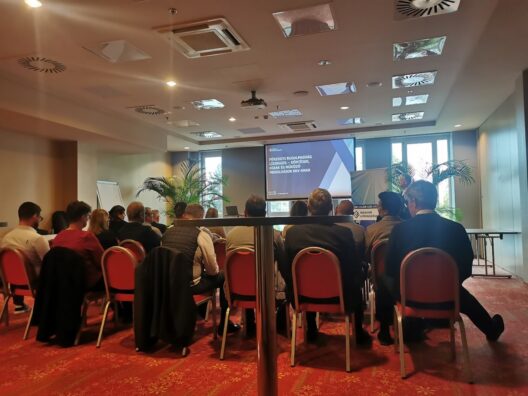
Today, digitalization means far more than simply adopting new technologies and software solutions. Its true value lies in how effectively we can organize, connect and utilize the information available to us in our everyday workflows. This was one of the key perspectives presented by WHB Group experts at the Hungarian Leasing Association’s “On the Path to Growth” professional event in Győr.
At the event, held in Győr on 20 October 2026, Julianna Tóth, BIM Manager, and Bálint Török, BIM Manager, represented WHB Group. Their presentation, entitled “Growth and Continuous Development: How Can a Hungarian Company Succeed?”, focused on the potential hidden within data, the practical application of digital building models, and the role of artificial intelligence in supporting professional workflows.
Information alone does not create value
One of the central questions of the presentation, built around the concept of “From Data to Value”, was simple: what do we do with the information available to us?
Construction projects generate vast amounts of data, ranging from plans and technical documentation to spreadsheets, photographs, cost information and facility management data. The challenge is not simply having access to this information, but managing it in a structured, readily accessible form that can be effectively utilized across different processes.
This is precisely where digital building models open up new possibilities. A model is far more than a three-dimensional representation of a building. When appropriately structured, individual elements can be linked to geometric and technical data, documentation and even cost information. The resulting structured dataset can then be utilized across multiple areas, including construction, cost planning, handover and facility management.
Artificial intelligence as a tool
The presentation also explored the practical applications of artificial intelligence in the construction industry. In the approach presented, AI is not the solution in itself, but rather a tool that supports professionals in their work.
Among the practical examples highlighted were data validation and categorization, including comparing information from different documents and organizing thousands of cost items according to different categories of work.
The presentation also emphasized that the first step towards digitalization does not necessarily involve purchasing another technology or software solution. It is much more important to determine what problem we actually want to solve.
Is it difficult to find the information we need? Are we entering the same data multiple times? Do we need to gather information required for decision-making from numerous separate documents?
Identifying these challenges can provide the foundation for digital developments that create genuine value.
Continuous development for greater competitiveness
The concluding message of the presentation was that as artificial intelligence becomes increasingly widespread, the knowledge and skills required for efficient work are also evolving. Openness, a willingness to learn, effective communication and critical thinking are playing an increasingly important role in making the most of technological opportunities.
Digitalization and artificial intelligence do not create value on their own. They contribute to business development when they enable us to use the information available to us more effectively, resulting in better decisions, more transparent processes and less unnecessary work. For WHB Group, digitalization is not technology for technology’s sake. It is an opportunity to transform available information into tangible value that can be applied in everyday work.
Through practical examples, Julianna Tóth and Bálint Török demonstrated this approach to the professional audience in Győr.