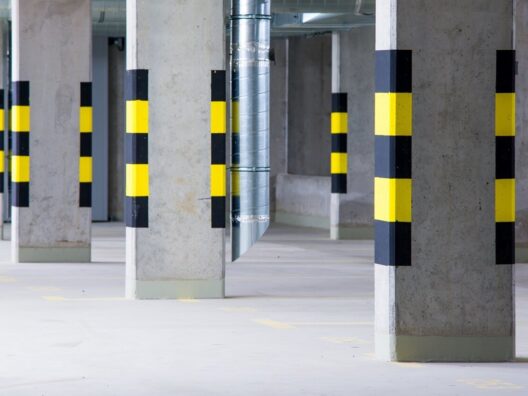
Due to a range of demographic, social and economic changes, demand for and the need for multi-storey car parks and indoor parking facilities have increased significantly in recent years. At the same time, the surface finishing requirements of these spaces have also changed considerably.
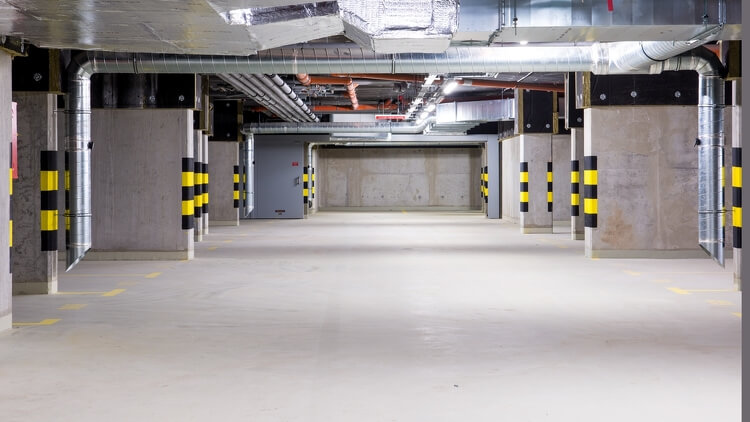
Unlike surface-hardened or polished and impregnated concrete, or asphalt pavements, the installation of rigid or flexible resin systems has now become almost a standard expectation.
As a result, Mapei also plays an active role in these construction tasks through its OS-certified and tested systems.
Just a few examples from ongoing projects:
the Dózsa György Road underground garage, covering 30,000 square metres, implemented by West Hungária Bau Kft. as main contractor and Épszerk-Pannónia Invest Kft. as structural construction subcontractor;
the indoor parking facilities of the Váci Greens office buildings, covering 25,500 square metres;
the indoor parking facility of the Nordic Light Tower office building, covering 10,000 square metres;
the indoor parking facility of the Arena Business Campus office building, covering 8,000 square metres.
But why resin?
The following properties explain why investors prefer this material:
it can be vapour-permeable, but also vapour-proof;
it is watertight, CO₂-resistant and offers high chemical resistance;
it can be rigid or flexible, and may even provide crack-bridging capability of up to 0.3 mm;
in addition to its high abrasion resistance, it also has high bond strength, and can be applied in varying thicknesses, starting from as little as 0.5 mm;
it is weather-resistant, has very low volatile organic compound emissions, and is easy to maintain;
it enables fast installation and is characterised by quick and easy repairability;
in addition, it offers a wide colour palette for an aesthetic appearance, while its fire protection classification may be A2 or Bfl-s1, making it suitable even for use on escape routes.
What are the basic requirements for resin flooring installation, and what potential pitfalls should be considered?
For a durable surface finish, the substrate may be a stable, solid concrete or asphalt surface capable of withstanding the expected combined loads.
Required concrete strength values:
Compressive strength: minimum 25 MPa
Tensile strength / pull-off strength: minimum 1.5 MPa
(1.2 MPa is generally accepted in non-industrial areas of use).
However, it is important to ensure that the surface is clean and dry, with relative humidity below 4% — although this is not required for water-based systems. The surface should be slightly rough and absorbent, and free from oils, dust and contaminants.
Furthermore, the flatness and slope of the surface must comply with the function of the area and the specified requirements.
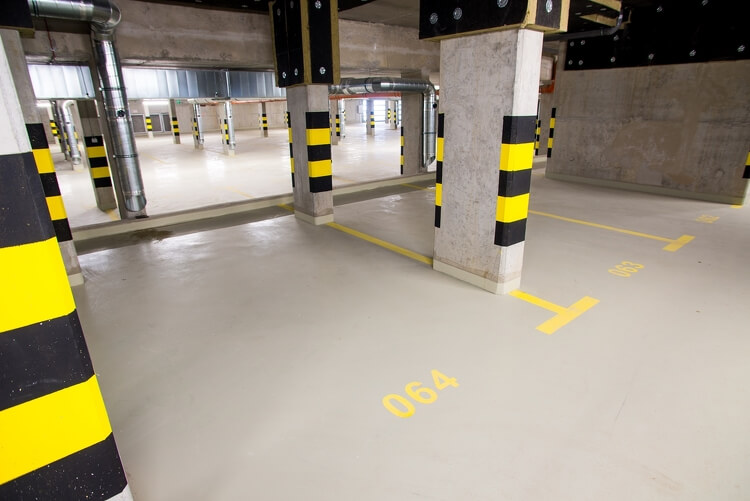
As the system is built up in a thickness of 1–4 mm, it is not capable of compensating for serious mechanical or structural defects in the concrete substrate slab. It is therefore important to identify and correct any defects through concrete stitching, levelling, resin mortar or fast-setting cement-based levelling compounds.
Surface preparation can be selected according to the substrate, but it must not be overlooked: grinding, shot blasting or milling in the case of asphalt. This process is also suitable for revealing serious defects beneath the thin cement laitance layer, enabling them to be repaired.
The basis of every system is a properly selected epoxy or PU primer, which is able to penetrate deeply into the substrate and bond firmly to it. It must also be capable of receiving the broadcast kiln-dried quartz sand, which is an essential component of properly installed parking facility systems.
Quartz sand offers several advantages:
based on grain size, it can regulate material consumption and layer thickness;
it provides high abrasion resistance;
it creates an anti-slip surface;
and it can also help release vapour coming from the substrate.
What intermediate or topcoat layer should be selected?
This depends on the flexibility requirements of the given surface.
For ground-bearing slabs, it is sufficient to apply one or two layers of pigmented epoxy resin with sand filling and/or broadcasting as a rigid system.
For intermediate slabs, the use of a PU resin membrane with a crack-bridging capability of at least 0.3 mm is recommended, also finished with flexible topcoat resins and, where required, UV-stable products.
For ramps, the most important properties of the system are slip resistance and load-bearing capacity. In this case, a crack-bridging capability of 0.15 mm is sufficient, which can also be achieved with PU resins. These systems can likewise be sealed with flexible topcoat resins and, where required, UV-stable products.
For rooftop-level surfaces, the requirements are more complex, and therefore the layer build-up used is also more sophisticated. After priming, a highly flexible membrane must be applied, followed by a load-bearing membrane, which can then be sealed with UV-stable and flexible topcoat resins. However, the system does not replace the waterproofing layer applied to the roof structure.
“Once the surface has been completed, it is essential to request maintenance recommendations from the contractor so that the newly installed surfaces can retain their original appearance and quality over the long term. If you require expert advice or application technology support, please contact us to ensure that your installation is completed properly the first time,” Mapei Kft. told our publication.