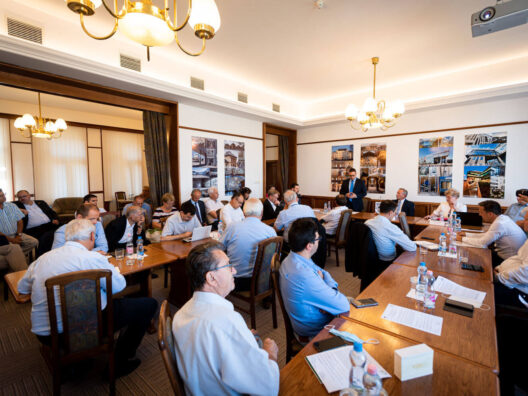
The National Federation of Hungarian Building Contractors (ÉVOSZ) held an extended presidency meeting in the afternoon, during which several topics were discussed. First, the government’s new brownfield housing VAT programme was presented, followed by a presentation on the implementation of the Vocational Training Act. Participants also reviewed the results of the recent period and assessed the state of the industry in light of the changes brought about by the coronavirus pandemic.
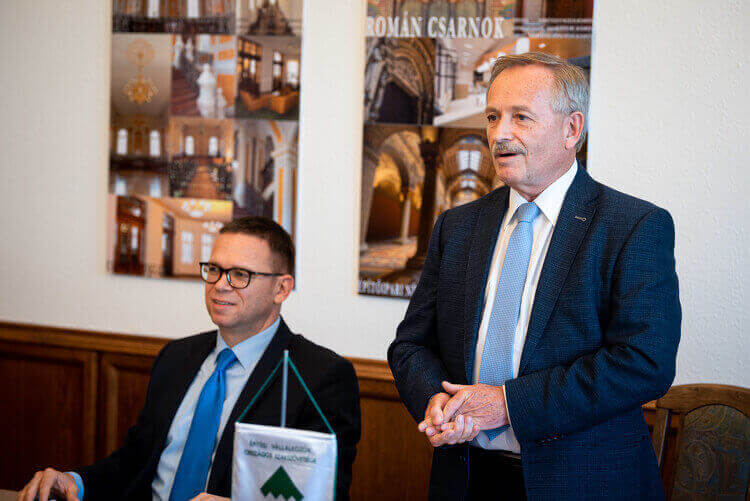
Balázs Fürjes and László Koji
Click on the image to open the gallery.
The event first addressed the introduction of the 5% VAT rate for housing in brownfield areas. Introducing State Secretary Balázs Fürjes, who spoke on the topic, ÉVOSZ President László Koji emphasised that, in the organisation’s view, the package of measures is important, highly timely and extremely urgent.
He explained that construction industry capacity is available, and that the sector had begun 2020 with the same momentum as the previous year. At the same time, he expressed concern that the number of final building permits was 35% lower compared with the previous year, and also raised the question of whether contracts for the projects under the new brownfield action programme could be signed in 2020.
Agreements May Be Concluded in September
At the beginning of his speech, Balázs Fürjes stressed that the timing of contract signings under the new framework would depend on the speed of construction companies, while the government would create the necessary conditions much sooner.
Before elaborating further, he recalled that two types of brownfield areas would be defined. The first category comprises immediate brownfield areas, where — as the name suggests — prepared projects can be launched straight away. The second category includes medium- and long-term brownfield action areas, where physical and legal preparation is required before work can begin.

Balázs Fürjes
He pointed out that the National Assembly is expected to adopt the legislative amendments by the end of the month, enabling the government — in consultation with local municipalities — to designate the first immediate action areas by September at the latest, covering an area in the order of one hundred hectares. Contracts for the first projects are also expected to be concluded that month, potentially allowing construction to begin this year on at least several hundred, and possibly as many as one thousand, new homes.
Affordable Housing, the Integration of Brownfield Areas and Support for the Construction Industry
His remarks made clear that brownfield areas, formerly used mainly for industrial and transport-related functions, represent the hidden reserves of cities. They are generally well accessible, yet currently underutilised and tend to pose a challenge in urban planning.
The new programme turns this obstacle into an opportunity, with the government pursuing three main objectives.
On the one hand, the aim is to ensure the construction of homes available at affordable purchase prices and rental fees. On the other hand, the government intends to integrate these former brownfield zones into the urban fabric. Another key objective is to stimulate the economy and preserve and create jobs by providing new opportunities for the construction industry, which employs half a million people in Hungary.
Accelerated Permitting to Be Introduced in the Affected Areas
Under the brownfield housing VAT programme, the VAT rate on the purchase of homes built in the designated areas will be 5%, while the rental of such properties will remain VAT-exempt. In addition, developments in these areas — not only residential construction projects, but also commercial developments — may be implemented under an accelerated, simplified and favourable permitting regime similar to that applied to investments of major importance for the national economy.
His remarks also revealed that, together with the medium- and long-term brownfield action areas, the second phase of the programme, affecting more than 1,000 hectares, will continue for several years.
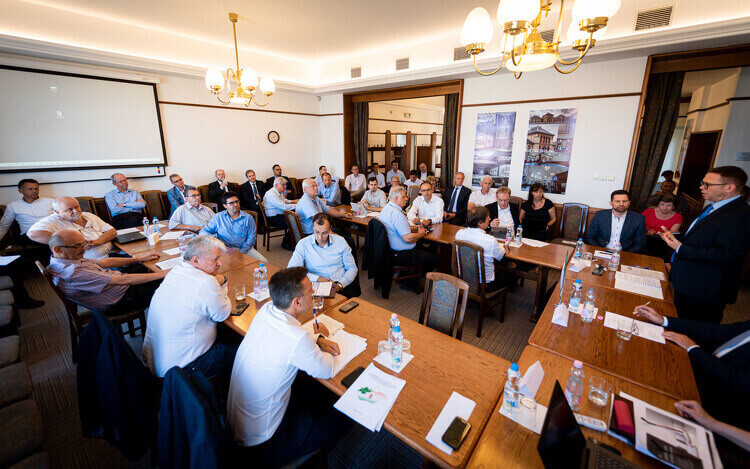
This was followed by a presentation by ÉVOSZ Vice-President Istvánné Tóth on the new vocational training system in the construction industry and, within this, on construction-related vocational education. During her presentation, she gave a detailed overview of several elements of the changing system. After the subsequent discussion, the meeting moved on to its third topic, which made up the second half of the session: reports on the situation of the construction industry following the coronavirus pandemic.
The Pandemic Had a Particularly Negative Impact on Municipal Commissions
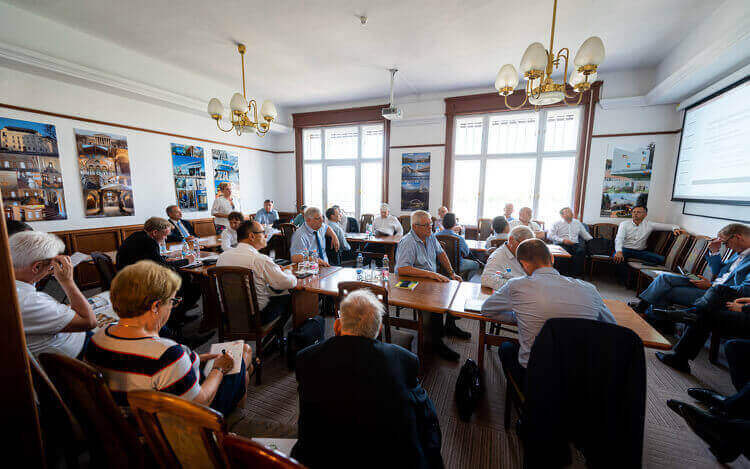
As ÉVOSZ’s regional representatives primarily came from the field of building construction, three ÉVOSZ Vice-Presidents spoke before them, each approaching the topic from the perspective of their respective subsector.
Tibor Keszthelyi, Chairman and CEO of Főmterv Zrt., spoke from the perspective of the design sector. First addressing the positive aspects, he noted that over the past three months, market participants had made significant progress in digitalisation, even if this had previously been a slower process. He also pointed out that certain negotiation processes had accelerated.
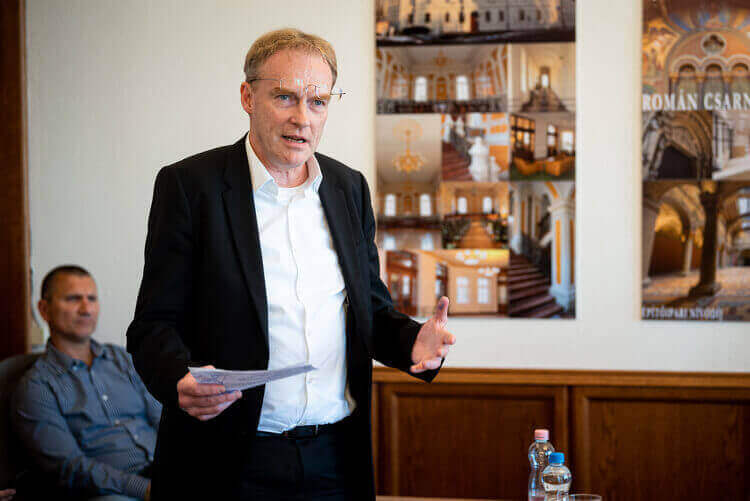
Tibor Keszthelyi
Regarding order books in civil engineering, he said that railway design projects had entered the market, while road construction design assignments had already been lower in the first half of 2020 than a year earlier, as previously planned. In civil engineering, he primarily mentioned the significant slowdown of investments financed under the KEHOP programme, including water engineering, wastewater and drinking water development projects. He explained that this was not necessarily connected to the COVID pandemic.
In the case of building construction orders, he pointed to the shutdown of the municipal sector in the field of design as a result of the virus. At present, these clients are taking a wait-and-see approach, meaning that the subsector is currently working on contracts carried over from earlier periods.
Water Engineering Orders Have Slowed Significantly
Representing the civil engineering construction sector, Antal Varga, Managing Director of Duna Aszfalt Kft., presented key figures on the road construction, railway construction, water engineering and waste management sectors. In this field, where clients are predominantly state and municipal bodies, he based his assessment on public procurement data, comparing figures as of 20 June this year with those from 2019 on a pro rata basis, focusing on awarded contracts as an indication of future work.
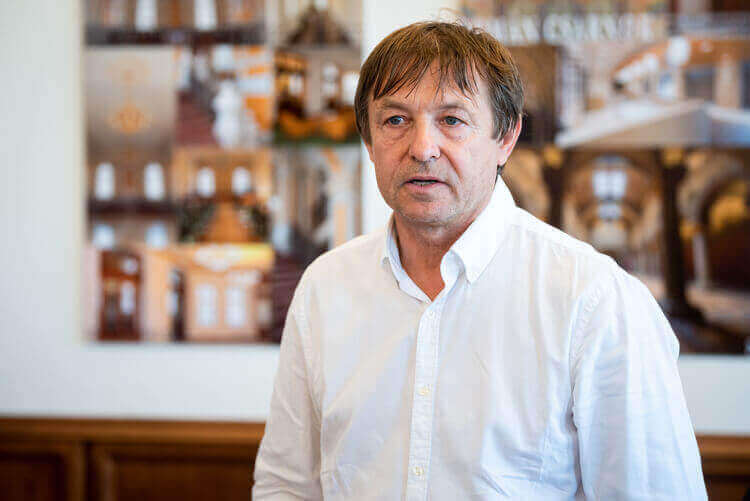
Antal Varga
Road construction currently stands at only around 35%, while water engineering is at just 5% — an explicitly low level. Railway construction, however, stands at 55%, making it the only sector that is currently ahead of its performance compared with the previous year. Waste management figures are at 25%.
At the same time, according to his summary, there are currently no significant disruptions in ongoing works, either in civil engineering or in building construction, and state projects are also having a positive impact on contractors.
The Picture Is Complex in the Installation Sector
Representing the installation subsector, Vice-President Sándor Bujdosó, Chairman and CEO of VIV Zrt., reported, among other things, that larger companies are coping well with the situation and are expected to have work until the end of the year. By that point, however, new investments will need to enter the market.

Sándor Bujdosó
Private-sector clients halted their developments, which resulted in smaller companies being left without work. He also recalled that, after several major investments were completed in 2019, companies found themselves in a position where they had to look for new work at a time when demand was not necessarily present.
This partly led to a reconsideration of wage levels, while among smaller market players, the disadvantages of black-market employment also came to the fore. Workers leaving such arrangements would expect the same wage levels even when taxes and contributions are included.
Municipal Investments Are Also Missing from Building Construction
This was followed by reports from the presidency members on the regional situation:
Miklós Bakos, CEO of HUNÉP Zrt., summarised the past quarter in the construction industry in Eastern Hungary;
István Derczó, Managing Director of Weinberg ’93 Kft., reported on North-Eastern Hungary;
Péter Gönczöl, Managing Director of STRABAG MML Kft., covered Central Hungary;
János Knáb, Managing Director of Merkbau Kft., presented the situation in the Southern Great Plain;
József Dormán, CEO of ZÁÉV Zrt., spoke about Western Hungary;
while Attila Peterka, Strategic Director of West Hungária Bau Kft., summarised the past construction quarter in North-Western Hungary.
Their assessments primarily approached the situation from the perspective of building construction
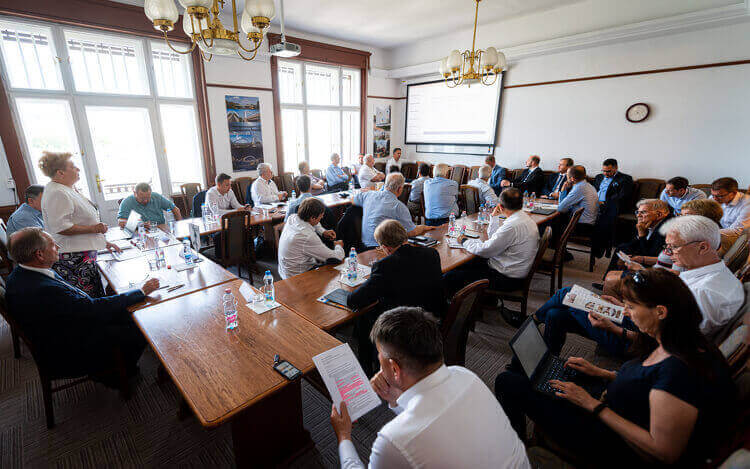
The leaders of the sector’s key companies generally reported similar experiences, highlighting the halt in municipal commissions and the resulting gap in the market, as well as the problems that may be expected in the future if these projects do not restart.
Government investments are still ongoing; however, participants noted that they had encountered rather unpredictable behaviour on several occasions in the commercial sector.