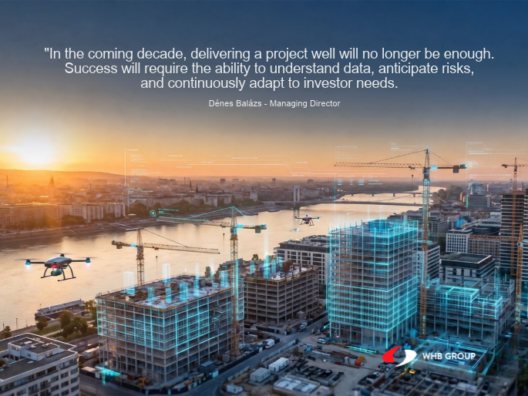
The period ahead for the construction industry will not be defined by a single technological innovation or market shift. Instead, several closely interconnected developments will transform the way investments are planned, delivered and subsequently operated.
Digitalisation, labour market challenges, energy and material efficiency, sustainability requirements, and increasing investor risks are all creating the need for a new operating model among construction companies. In the decade ahead, competitive advantage may therefore belong not necessarily to those with the greatest capacity, but to those able to adapt quickly, responsibly and predictably.
Construction is evolving into a complex service
The role of a modern general contractor no longer ends with organising the construction site. Investors are increasingly looking for partners that can also provide a stable professional foundation in design, project preparation, cost and risk management, multidisciplinary coordination, quality assurance and information management.
As a result, performance in the construction industry can increasingly no longer be measured solely in square metres delivered. Predictability, transparency, the quality of decision-making and a company’s ability to respond quickly to changes affecting a project are becoming equally important.
A key part of WHB’s operations is technical preparation, project management, the coordination of procurement and subcontractor processes, quality assurance, and the integrated management of the various parties involved in project delivery.
There will be no competitive operation without data
One of the most important changes of the coming decade will be the growing role of data-driven project management. Companies will not only have access to more information, but will also need to process it faster, more systematically and more effectively.
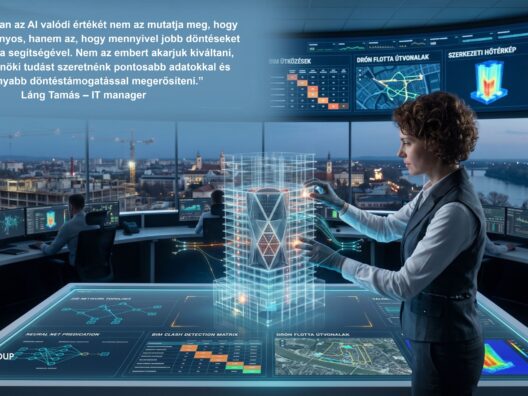
Digital project monitoring, BIM, automated document management and AI-supported analytics can help identify risks earlier, detect deviations more accurately and support better-informed decision-making.
This does not mean that human experience will become less important. On the contrary, digital tools create real value when the information they provide is interpreted by experienced professionals.
Sustainability will become an operational priority
As 2030 approaches, sustainability is expected to become less of a separate corporate topic and increasingly an integral part of everyday investment and project decisions.
WHB’s sustainability roadmap identifies the improvement of ESG data quality, the expansion of supplier-related data, the development of project-level carbon data, circular construction practices and more integrated ESG governance as key areas of focus.
The construction company of the future will therefore need to think simultaneously in technical, economic and environmental terms. Compliance with regulations alone will not be enough. Companies will also need to demonstrate how their chosen solutions contribute to the long-term value of an investment.
The ability to adapt will be decisive
WHB’s internal materials also highlight the importance of adapting to a changing market environment, diversification, maintaining a presence across multiple areas, as well as continued development in BIM and AI.
In the years ahead, the key question will therefore not be which company owns the most equipment or has the greatest capacity. What will matter more is who can bring together accumulated experience, technological opportunities and evolving investor expectations within a single, coherent operating model.
“In the coming decade, delivering a project well will no longer be enough. Success will require the ability to understand data, anticipate risks and continuously adapt to investor needs. The construction company of the future will not simply provide capacity; it will provide expertise, predictability and long-term security for its partners.”
Balázs Dénes – Managing Director